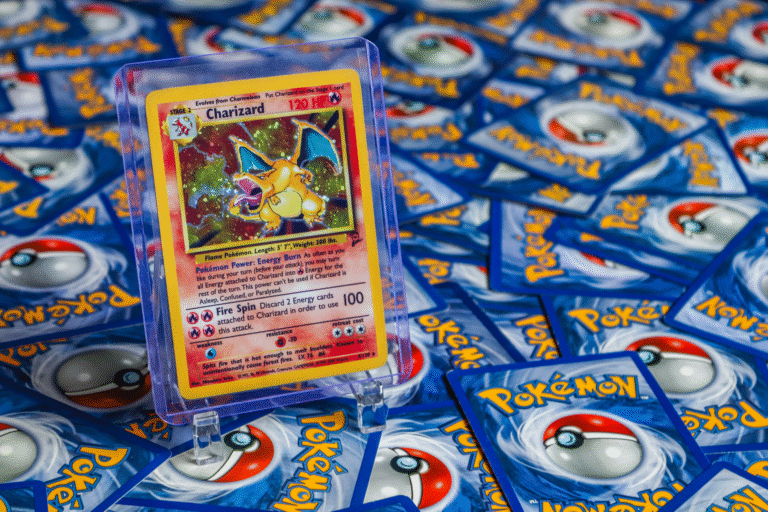
The EX Delta Species Vaporeon Holo card, specifically the #18/113 from the EX Delta Species set, trades between $125 and $130 USD in near mint condition as of 2026. This water-type Pokémon card represents one of the mid-tier collectibles in the Delta Species lineup—valuable enough to justify protective storage, but not rare enough to command the five-figure prices of first-edition holographic cards or black-bordered treasures.
For collectors entering the vintage Pokémon market, this Vaporeon offers a meaningful investment without requiring the premium pricing or extreme scarcity of earlier era cards. The price range reflects current market reality from established TCGplayer and CardTrader listings, where consistent trading activity sets floor and ceiling values. A near mint ungraded copy typically sells around $129.99, making it accessible to mid-level collectors, whereas the same card in moderately played condition drops to roughly $60, and graded mint examples can exceed $1,500.
Table of Contents
- What Determines the Price of EX Delta Species Vaporeon Holo?
- Condition Tiers and Their Impact on Vaporeon’s Value
- Where to Source Price Data and Current Market Listings
- Graded Versus Ungraded: Cost-Benefit Analysis for Buyers
- Price Volatility and Market Timing Risks
- Comparing Vaporeon-δ to Other Delta Species Cards
- Verification and Authentication When Buying Online
What Determines the Price of EX Delta Species Vaporeon Holo?
The delta Species set introduced a mechanical gimmick in the early 2000s—Pokémon with altered types, denoted by the delta symbol (δ). Vaporeon-δ carries this unique designation, which affects both its gameplay relevance and collectibility. cards from this era that feature the delta mechanic retain appeal among players who rebuild decks from the original TCG competitive format, adding demand beyond pure collector interest. The holographic pattern on card #18/113 further boosts value compared to non-holographic versions, as the visual appeal drives purchases from display-oriented collectors.
Set scarcity matters significantly. EX Delta Species was printed in moderate quantities during 2005, making high-grade copies available but still finite. Unlike the mass-market sets of recent years, copies in near mint condition require time to locate and show visible wear typical of cards stored for two decades. A moderately played example might show light edge wear or a faint crease—imperfections that drop value by nearly 50% despite the card remaining playable and readable.
Condition Tiers and Their Impact on Vaporeon’s Value
Condition grading exists on a spectrum, and understanding each tier prevents overpaying for wear you didn’t expect. Near mint (NM) condition means the card shows minimal play wear—perhaps a light surface scuff or two minor edge marks visible only under direct light. This $125-$130 range covers ungraded cards where buyers rely on seller photos and descriptions. Moderately played (MP) cards show obvious wear: visible edge wear, light creasing, or surface marks that catch light, which explains the $60 pricing.
A buyer expecting a display-quality card but receiving a moderately played example will face disappointment, so always request close-up photos of corners and edges before purchasing. Professional grading through psa (Professional Sports Authenticator) adds cost but removes guesswork. A PSA 9 Mint Condition grade can push the same Vaporeon to $1,500 or higher, a roughly 10-fold premium over ungraded near mint. This dramatic jump reflects three factors: scarcity of high-grade copies (achieving PSA 9 or higher on a twenty-year-old card requires exceptional luck), the authentication value investors seek, and collector psychology—a slabbed card in a protective case reads as “investment grade” regardless of the underlying card quality. For players or casual collectors, the ungraded path saves money; for serious investors tracking portfolio value, the grade matters significantly.
Where to Source Price Data and Current Market Listings
TCGplayer’s price guide serves as the reference standard for Pokémon card collectors. The platform aggregates listings from thousands of vendors, creating a market-wide average that reflects real trading activity. CardTrader similarly lists active buy/sell prices from individual sellers worldwide, useful for finding international pricing or negotiating directly with collectors. CardCodex provides card-specific details including image galleries and set information, confirming the exact card variant (some sets feature multiple Vaporeon printings).
The difference between TCGplayer’s aggregate price and what you’ll actually pay at a specific shop matters. A vendor may price a near mint copy at $149 while another asks $99 for the same grade—the $50 spread reflects shipping costs, seller overhead, and market positioning. PokemonWizard and Pikawiz cards databases track historical price trends, allowing collectors to spot whether a $130 card has held value or dropped from $200 two years prior. Checking multiple sources before purchasing prevents buying at peak pricing during temporary demand spikes.
Graded Versus Ungraded: Cost-Benefit Analysis for Buyers
Grading costs $10 to $25 per card through PSA, Beckett, or CGC depending on turnaround speed. For a $130 ungraded card, that 15–20% grading expense only justifies itself if you expect to resell at premium prices or if you plan to hold for decades. A PSA 8 grade (light play) might add $300 to the price, but cards graded as 6 or 7 (moderate to heavy play) sometimes don’t recoup grading fees—you pay $20 to grade a $60 card, then sell it for $75, netting worse returns than selling ungraded.
Ungraded cards suit collection-focused buyers who won’t resell. The Vaporeon will live in a binder or display case, where visual condition is what matters to you personally, not third-party verification. Graded cards suit investment-focused buyers tracking portfolio value or those planning to auction on eBay, where a PSA label attracts serious bidders willing to pay premiums for authenticated mint examples.
Price Volatility and Market Timing Risks
Pokémon card values fluctuate based on nostalgia waves, Pokémon Company set releases, and broader collectible market sentiment. The 2020–2021 boom drove vintage card prices to historic highs; the 2023 correction saw prices stabilize but not collapse, settling at current ranges like $125–$130 for this Vaporeon. Buying during hype cycles risks overpaying—if you paid $200 for this card in 2021, its current $125 price represents a 37% loss, despite the card being physically identical.
Condition stability presents another risk: graded cards sit in plastic slabs but ungraded copies risk environmental damage. A $130 near mint card stored in a humid closet or exposed to sunlight may fade or curl within five years, dropping to moderately played value. Collectors serious about price preservation invest in proper storage: acid-free sleeves, top-loaders, controlled temperature, and low humidity. Neglecting storage turns a $130 card into a $60 card through your own handling.
Comparing Vaporeon-δ to Other Delta Species Cards
Not all Delta Species holographics trade at $125–$130. Charizard-δ from the same set commands $800+ for near mint copies due to Charizard’s broader market appeal and lower print runs of popular Pokémon. Rayquaza-δ, another colorful star of the set, hovers around $200–$300. By contrast, lesser-known delta Pokémon like Hitmonchan-δ might trade at $30–$50.
Vaporeon’s pricing sits in the middle-tier because water Pokémon carry steady collector interest but lack the secondary hype of dragon or fire types. This tiering matters when deciding whether $125 represents fair value. If you’re building a delta collection, Vaporeon offers accessible entry compared to the flagship megas while providing visual appeal superior to obscure commons. The comparison also reveals that paying $125 for this specific card today is reasonable, but overpaying by 50% ($190+) would indicate you’ve encountered either a particularly well-preserved copy, a seller inflating prices, or a temporary market spike.
Verification and Authentication When Buying Online
Counterfeit Pokémon cards exist, particularly for high-value vintage cards, so purchase verification matters. The EX Delta Species set ended in 2005, making originals consistently two decades old. Authentic copies show the correct holofoil pattern specific to the era—distinct from modern rainbow rares or other contemporary printing techniques. Card edges display exact centering and registration consistent with the set’s production runs, details visible in high-resolution seller photos.
Buy from established vendors with buyer protection policies. TCGplayer seller ratings, CardTrader user histories, and eBay return policies provide recourse if you receive a card misrepresented in photos. A $130 card purchased from a seller with 0 ratings carries risk; the same card from a vendor with 50,000+ sales and 99% positive feedback carries confidence worth the potential price premium. Authentication services like PSA certification bypass this concern entirely but add cost and grading time.
- —