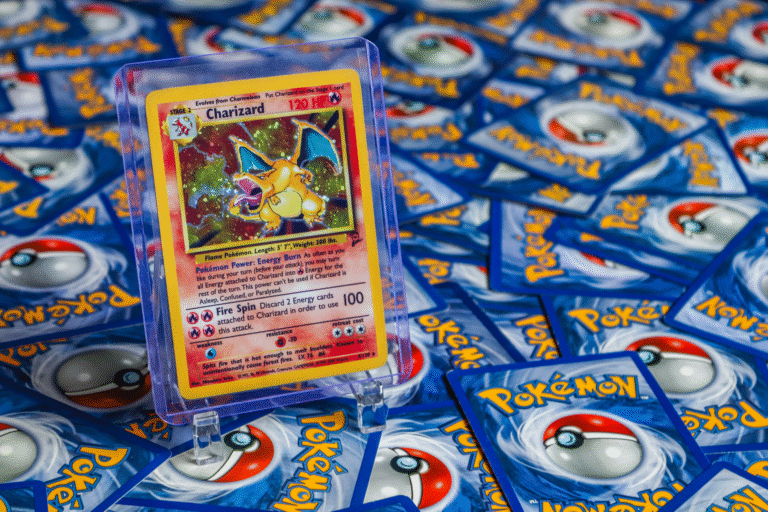
The EX Delta Species Vaporeon Holo card #18 currently trades between $60 and $125 for ungraded copies in played to near-mint condition as of July 2026, though premium reverse holo variants and graded specimens command significantly higher prices. This mid-tier pricing reflects Vaporeon’s position as a sought-after Water-type Pokémon card from one of the most collectible modern ex-series sets, balancing availability against collector demand.
For example, a lightly played standard holo copy typically sells for around $125, while the same card in moderately played condition drops to approximately $60—a sharp difference driven by visible wear that collectors notice immediately. The Delta Species set itself contains 113 cards total, and Vaporeon’s status as card #18 places it in the rare holo category, making it more accessible than secret rares but still valuable enough to matter in collections and trading portfolios. The gap between different versions of this same card—particularly between standard and reverse holo—reveals important pricing mechanics that collectors often overlook when comparing market listings.
Table of Contents
- What Determines Pricing for EX Delta Species Vaporeon?
- Graded vs. Ungraded Pricing: The Dramatic Price Multiplier
- Standard Holo vs. Reverse Holo: The Consistent 2-3x Premium
- Market Availability Across Trading Platforms
- Condition Grading’s Real Impact on Resale Value
- Investment Comparison with Nearby Delta Species Cards
- Current Marketplace Dynamics and Seller Patterns
What Determines Pricing for EX Delta Species Vaporeon?
Vaporeon’s price within the EX Delta Species set is determined by a combination of set scarcity, card rarity designation, and the specific mechanics of the card itself. The Delta Species set has remained in consistent collector demand since its original release, which keeps supply tighter than more recent sets. As a rare holo (designated by the star symbol), Vaporeon appears less frequently in booster boxes than common or uncommon cards, but more frequently than the set’s ultra-rares and secret rares.
This middle position in the rarity hierarchy directly correlates to its mid-range pricing. The card’s type—Water—also influences demand, as Water Pokémon have maintained collector interest across multiple generations. Collectors often build type-focused collections or seek complete sets from their favorite eras, and Vaporeon’s established role in competitive play history adds a layer of appeal beyond pure nostalgia. A collector building a complete Delta Species set will eventually need this card, creating baseline demand that supports the $60-$125 price floor for ungraded copies.
Graded vs. Ungraded Pricing: The Dramatic Price Multiplier
The most striking pricing gap in the EX Delta Species Vaporeon market is between ungraded and professionally graded specimens. An ungraded reverse holo in near-mint condition might fetch $200-$300, but a psa 9 graded reverse holo from the same era sells for $1,499.99—a 5 to 7 times higher price for a single grading level. This dramatic multiplication happens because grading certificates provide third-party authentication and condition verification that buyers cannot assess themselves from photos or in-hand inspection alone.
High-grade copies become investment-grade assets rather than simple collectibles, attracting both serious collectors and speculators. However, the grading premium comes with real costs and timing considerations. PSA grading fees, turnaround delays, and the risk that a card graded as an 8 or lower can trap you with a grading cost that exceeds the card’s ungraded value mean that casual collectors often lose money by grading lower-condition copies. A moderately played ungraded Vaporeon at $60 would cost $50+ to grade and potentially return a PSA 5-6, resulting in a card worth $80-120 after paying the grading fee—a net loss once you account for shipping and time.
Standard Holo vs. Reverse Holo: The Consistent 2-3x Premium
Reverse holo versions of EX Delta Species Vaporeon consistently trade 2-3 times higher than their standard holo equivalents in matching condition. A standard holo in near-mint ungraded condition sits around $125, while a reverse holo near-mint ungraded copy ranges from $129.99 to $300.00 depending on exact condition assessment and seller pricing. This 2-3x differential is standard across most Pokémon card markets and reflects the reverse holo’s lower pull rate during original set distribution—fewer packs contained reverse holos, making them inherently scarcer.
The visual difference between standard and reverse holo is subtle but meaningful to collectors: in standard holo, the entire card back is shiny/holographic, while reverse holo features a holographic background with a non-holographic character illustration. Many collectors prefer the reverse holo’s aesthetic, and that preference directly translates to higher demand and higher prices. When shopping across multiple marketplaces like TCGplayer, CardTrader, and eBay, you’ll notice that identical-condition reverse holos consistently command premium prices—this is not variation in seller pricing but rather consistent market recognition of scarcity. If you’re buying for value rather than aesthetics, the standard holo version offers better price-to-condition ratio.
Market Availability Across Trading Platforms
EX Delta Species Vaporeon maintains active listings across all major Pokémon card trading platforms: TCGplayer, CardTrader, eBay, Troll and Toad, and CardCodex. TCGplayer typically shows the tightest clustering of prices due to its marketplace averaging and seller review system, while eBay prices can vary wildly—from deals well below market ($80 for a near-mint holo) to inflated listings (asking $200+ for moderately played copies). Troll and Toad maintains consistent pricing with usually high-condition inventory, making it reliable for buyers who prioritize condition certainty over deal-hunting.
The challenge in using these platforms is that condition assessment varies between sellers. One seller’s “near-mint” might be another’s “lightly played,” creating genuine confusion when the same card carries different prices on different sites. CardCodex and CardTrader often provide detailed centering photos and wear descriptions, reducing this assessment gap, but require more time per listing to review. For this specific card, expect 3-5 listings across major platforms at any given time, meaning limited inventory—if you find a copy at your target price and condition, purchasing quickly is often wiser than waiting for a “better deal” that may not materialize.
Condition Grading’s Real Impact on Resale Value
The jump from moderately played ($60) to lightly played ($125) for ungraded Vaporeon represents the most visible condition threshold in pricing. Moderately played means visible creasing, edge wear, or surface scratches—flaws that catch light under inspection. Lightly played means minimal wear visible only under close examination. This single condition step creates a 2x price difference, which is why condition assessment is the most consequential decision when evaluating Vaporeon listings. A critical limitation: “near-mint” and “mint” vary in definition across sellers and platforms.
Some sellers use “near-mint” to mean 9-out-of-10 condition (equivalent to PSA 8-9), while others use it to mean “looks good in a sleeve” (closer to PSA 6-7). When the price difference between sellers is large—like $200 vs. $300 for similar-sounding “near-mint” reverse holos—the difference is usually in this definitional gap. Request close-up photos of corners, edges, and centering before purchasing, especially from eBay or marketplace sellers unfamiliar to you. A card that looks good at thumbnail size often shows wear when magnified, which then justifies a lower condition grade and lower resale value.
Investment Comparison with Nearby Delta Species Cards
EX Delta Species contains several Water-type and other sought-after cards that provide useful pricing comparisons for Vaporeon. Charizard-ex from the same set trades significantly higher (often $300-500+ ungraded, depending on version), while Blastoise-ex and Lapras-ex occupy similar price ranges to Vaporeon. This mid-range positioning makes Vaporeon useful for portfolio construction: it’s liquid enough to sell relatively quickly without the niche-collector pricing of higher rares, but valuable enough to justify collection space and storage investment. Collectors building Delta Species sets often purchase Vaporeon alongside other Water-types to complete their type or set collection, creating consistent baseline demand.
The tradeoff is that Vaporeon’s moderate price also means it attracts fewer speculative buyers than the set’s highest-priced cards. A buyer considering whether to allocate $125 to a Vaporeon or save toward a $400+ Charizard-ex is making a real opportunity-cost calculation. Vaporeon remains a reliable hold—unlikely to crash significantly but also unlikely to spike 50% in value the way a suddenly-trending card might. For collectors prioritizing collection completion over investment returns, this stability is a feature. For speculators, it means Vaporeon is a supporting piece rather than a portfolio anchor.
Current Marketplace Dynamics and Seller Patterns
Active sellers of EX Delta Species Vaporeon on TCGplayer currently list multiple copies across condition tiers, with no single seller dominating inventory. This distributed supply is healthy for buyers—it prevents artificial price inflation from a single seller controlling stock and suggests genuine collector turnover rather than speculative hoarding. Prices on TCGplayer’s marketplace have remained stable week-to-week throughout July 2026, suggesting equilibrium between supply and collector demand. When you see larger price swings (drops to $80 or spikes to $150+), they typically reflect temporary inventory shortages rather than fundamental value shifts.
CardTrader and CardCodex show similar stability, with reverse holo listings consistently higher than standard holo across all platforms. eBay auctions occasionally close below TCGplayer averages when multiple Vaporeons are listed concurrently, creating competition that drives prices down—a pattern worth monitoring if you’re building position. Conversely, when supply dries up temporarily (fewer than 2 listings across all major platforms), prices can creep up 10-15% before new inventory relists and prices normalize. As of July 2026, current market listings show stable mid-range pricing with no indicators of imminent shortage or oversupply, suggesting the $60-$125 range for ungraded copies will persist through the current quarter.