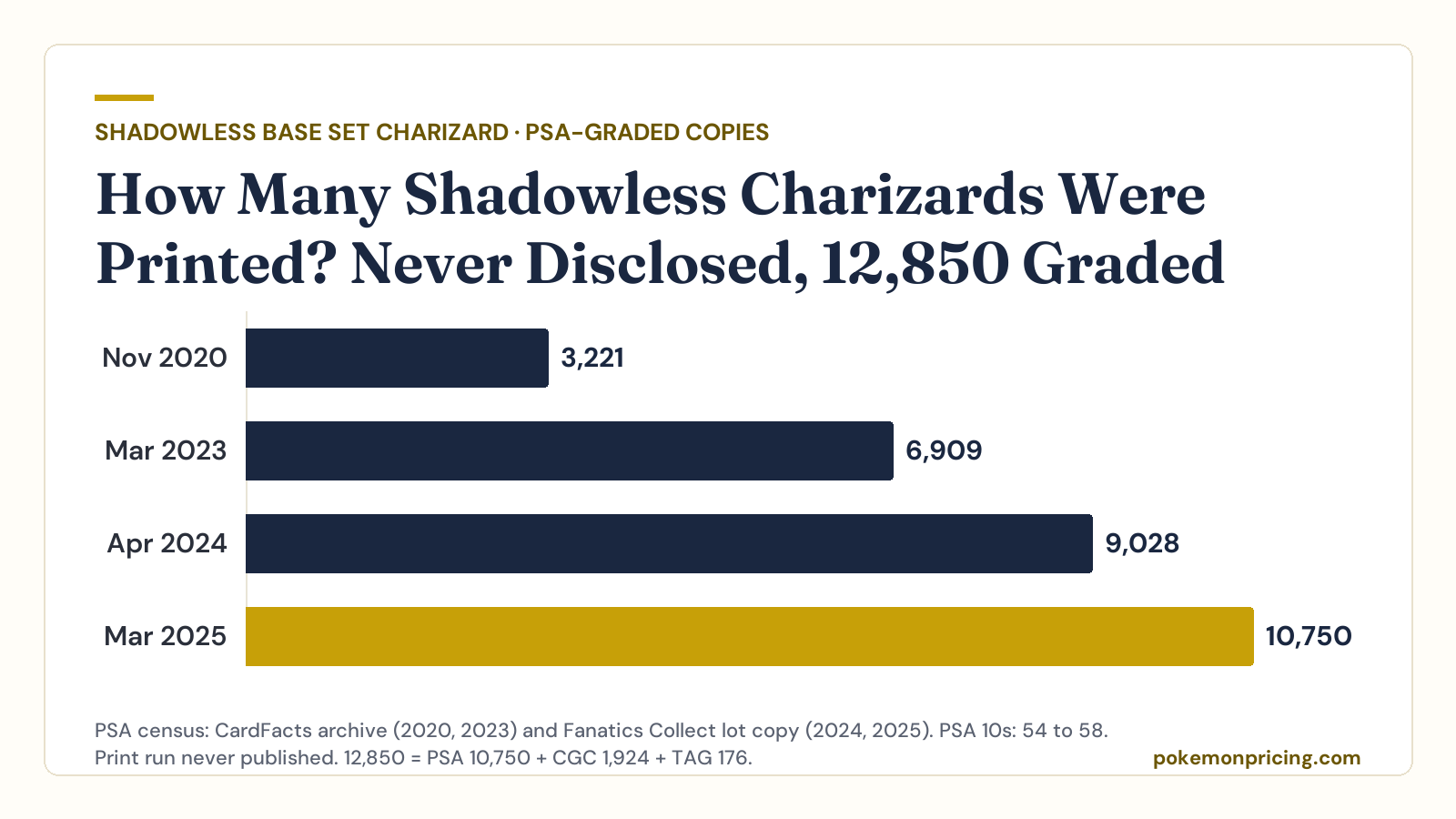
Nobody has published how many Shadowless Charizards were printed. Wizards of the Coast never released a print quantity for the Shadowless run, or for any 1999 Base Set print, so the hard number is the graded record: 12,850 Shadowless Charizard slabs, made up of 10,750 at PSA by late March 2025 plus 1,924 at CGC and 176 at TAG on October 6, 2026.
That 12,850 is a floor, and it counts grading records rather than cards: a regraded or crossed-over copy can be counted twice, and raw copies are not counted at all. An earlier version of this page put the Shadowless print at several hundred thousand copies, credited to an industry consensus it never named. No grading company, publisher or printer has published any such figure.
As of October 6, 2026: PSA 10,750 Shadowless Charizards graded, 58 of them PSA 10 (late March 2025, quoted from PSA’s census by Fanatics Collect; PSA’s own newest archived table, from March 2023, shows 6,909 and 57). CGC 1,924, with one Pristine 10 and 37 Gem Mint 10s. TAG 176, with one TAG 10. Highest PSA 10 sale found: $105,000 at PWCC in October 2021.
Three terms run through every number below. 1st Edition is the first Base Set print, marked with a small black Edition 1 stamp below the art box. Shadowless is the early print with no stamp and no drop shadow along the right edge of the art box. Unlimited is the later, far larger print that added the shadow. All three are Charizard 4/102 from the 1999 English Base Set.
How many Shadowless Charizards were printed? What the record says
No count exists. Asked in a January 2000 help chat whether it releases print run statistics, Wizards answered: “Though we are a publicly held company, we are not obligated to release that sort of information.” Nothing published since by Wizards, Hasbro or The Pokémon Company gives a Shadowless figure.
What the record does hold is a description of the run. Wizards’ own card FAQ, compiled from its help chats, answered a fan who asked why “the Base Set First Edition cards and some of the Regular edition cards have no shadow at the edge of the frame around the picture.” The answer: “That was how the cards were originally designed. After a while Nintendo asked us to make some changes in the cards (including adding that shadow) which we did.”
The same FAQ called those cards “just from the early print runs of the cards before we darkened them, thickened the font, changed the copyright, and added the drop shadow.” Runs, plural. Wizards never said how many there were or how many sheets any of them produced.
CGC describes two limited runs. In an April 2023 article, it explains that the 1st Edition run itself had no drop shadow and that “Shadowless cards would continue to be featured in the second limited print run of Base Set before drop shadows were finally added in Unlimited Base Set.” It sums up: “While Shadowless Pokémon cards were featured in both Limited Edition Base Set print runs, 1st Edition cards were only featured in one.” CGC’s Charizard guide adds that “Shadowless Base Set cards were released in limited quantities after 1st Edition’s print run.” CGC says both limited sets “had such short print runs”, but gives no quantity for either.
The early runs came fast. In February 1999, less than a month after the national launch, Wizards said in a press release that it was “gearing up for a fourth print run after only six weeks on the market”. Three runs were already behind it. Wizards did not say which carried the stamp, which lacked the shadow, or how many cards any made.
Sources disagree on the order of the prints. PSA’s 2016 Set Registry article quotes collector Scott Pratte: “Their price hierarchy echoes their release: 1st Edition being first, shadowless being second and unlimited being third”. CGC puts them in the same order. A PWCC lot description from April 2023 claimed the opposite, that “Wizards of the Coast printed the first English Base Set in the Shadowless design and added 1st Edition stamps later in production.” Lot copy is not a production record, and no Wizards statement found settles it.
This page does not estimate the Shadowless print. Pokemon Pricing publishes labelled estimates, method shown, for the Unlimited print in how many Unlimited Base Set Charizards were printed and for the late 1999-2000 print. The overview of how many Base Set Charizards exist sets the Shadowless count beside every other print.
The countable floor: 12,850 graded Shadowless Charizards
Adding PSA’s newest dated figure to CGC’s and TAG’s live counts gives 10,750 + 1,924 + 176 = 12,850 slabs. PSA holds 83.7% of them.
| Grader | Shadowless Charizards graded | Top grades | As of |
|---|---|---|---|
| PSA | 10,750 | PSA 10: 58 | Late March 2025 (Fanatics Collect, quoting PSA) |
| CGC | 1,924 | Pristine 10: 1; Gem Mint 10: 37 | October 6, 2026 |
| TAG | 176 | TAG 10: 1 | October 6, 2026 |
| BGS and SGC | Not readable | Report offline / behind a captcha | October 2026 |
| PSA + CGC + TAG | 12,850 |
PSA’s population report now sits behind an account sign-in, so the PSA figure comes from an auction house quoting PSA’s census. In a lot that sold in April 2025, Fanatics Collect wrote: “As of late March, only 58 of the 10,750 examples to hit the PSA grading floor have earned a 10 Gem Mint grade”. PSA’s own CardFacts table for the card, as archived in March 2023, is the newest PSA-hosted figure: 6,894 numerically graded copies plus 15 Authentic, or 6,909.
CGC’s report and TAG’s report were read live on October 6, 2026. BGS and SGC slabs are left out: Beckett’s whole site, pop report included, was offline, and SGC’s lookup sits behind a captcha.
How to identify a Shadowless Charizard
Three checks place a Base Set Charizard 4/102, in this order.
- No stamp. A 1st Edition copy carries a small black circular stamp reading Edition 1 just below the lower left of the art box. A Shadowless Charizard has nothing there.
- No shadow. Look at the right edge of the frame around Charizard’s picture. PSA describes Shadowless cards as having character boxes “without a shadow on their right border”. An Unlimited copy shows a dark drop shadow along that edge.
- The early-print look. PSA calls the Shadowless version duller colored. Wizards’ FAQ answer above lists the four things it changed after the early runs: darker color, a thicker font, a new copyright line and the drop shadow. A fan’s question in the same FAQ described the early cards as having “a thin HP text and no shadow from the picture, and lightened background”.
Against 1st Edition, the stamp is the check. Fanatics Collect’s lot copy says Shadowless cards “feature the same artwork, cardstock, and font as their 1st Edition counterparts.”
| 1st Edition stamp | Drop shadow on art box | PSA label | CGC set | TAG set | |
|---|---|---|---|---|---|
| 1st Edition | Yes | No | Charizard-Holo, 1st Edition | Base Set – 1st Edition – English | Base Set – 1st Edition |
| Shadowless | No | No | Charizard-Holo, Shadowless | Base Set (Shadowless) – English | Base Set – Shadowless |
| Unlimited | No | Yes | Charizard-Holo, no variety | Base Set – Unlimited – English | Base Set |
A title that says 1st Edition Shadowless is a 1st Edition
Fanatics Collect and PWCC title their 1st Edition lots Base Set Shadowless 1st Edition, because every 1st Edition card also lacks the shadow. A January 2025 Fanatics lot counted “124 PSA 10 examples of the 1st Edition Shadowless Base Set Charizard”. Headlines do the same: when Sports Illustrated reported that “A PSA 10 1st Edition Shadowless Charizard sold for $1,000,952.84 on eBay” in September 2026, that was a 1st Edition card. PSA, CGC and TAG all count Shadowless separately from 1st Edition, and a card with the stamp is not in any number on this page.
Check an older plain PSA Charizard-Holo slab
PSA files the card as 1999 Pokemon Game #4 Charizard-Holo, with Shadowless added as the variety. In 2019 PSA warned that “PSA started recognizing certain varieties within specific sets long after the company began grading the issue”, so “some of the population data may not reflect accurate numbers”. It did not say which varieties, or when it began noting Shadowless.
For this card, the risk runs one way. A Shadowless Charizard graded before PSA noted the variety sits on the plain Charizard-Holo line with the Unlimited copies, so PSA’s Shadowless count can run low. If you own an older PSA Charizard-Holo slab with no variety on the label, check the right edge of the art box. No shadow and no stamp means a Shadowless card in a plain label, and its sales record is on the Shadowless Charizard price history, not the Unlimited one.
PSA’s Shadowless Charizard count, 2020 to 2025
Two rows are PSA’s own archived CardFacts pages (November 2020, March 2023). The rest are lot descriptions quoting PSA’s census: PWCC, Fanatics Collect in 2024, Goldin and Fanatics Collect in 2025. Goldin notes that such figures are “accurate at the time a lot is posted for auction and is subject to change.”
| As of | PSA-graded Shadowless Charizards | PSA 10s | PSA 10 share | Source |
|---|---|---|---|---|
| November 2020 | 3,221 | 54 | 1.7% | PSA CardFacts (archived) |
| October 2021 | Over 5,000 | 55 | — | PWCC lot description |
| March 2023 | 6,909 | 57 | 0.8% | PSA CardFacts (archived) |
| Late April 2024 | 9,028 | 57 | 0.6% | Fanatics Collect lot description |
| February 2025 | More than 10,300 | — | Under 1 percent | Goldin lot description |
| Late March 2025 | 10,750 | 58 | 0.5% | Fanatics Collect lot description |
PSA’s count grew 3.3 times in under four and a half years, from 3,221 to 10,750, while PSA 10s went from 54 to 58. That is a net 7,529 slabs and 4 PSA 10s, a gem rate of 0.05% on the additions. The PSA 10 share fell at every step: 1.7% in November 2020, 0.8% in March 2023, 0.6% in late April 2024 and 0.5% in late March 2025. No PSA figure newer than late March 2025 was found.
Shadowless now has more slabs and fewer PSA 10s than 1st Edition. In the same late-March 2025 lot copy, Fanatics Collect put 1st Edition at “125 of the 4,821 PSA-graded examples”, a gem rate of nearly 2.6%. That is 2.2 Shadowless slabs for every 1st Edition slab, but fewer than half as many PSA 10s. A graded ratio is not a print ratio, since owners decide which cards are worth a grading fee. The 1st Edition side is in how many 1st Edition Charizards were printed.
PSA grade breakdown for the Shadowless Charizard
PSA’s two archived CardFacts snapshots, side by side:
| PSA grade | November 2020 | March 2023 |
|---|---|---|
| GEM MT 10 | 54 | 57 |
| MINT 9 | 582 | 751 |
| NM-MT 8 | 640 | 1,034 |
| NM 7 | 490 | 963 |
| EX-MT 6 | 523 | 1,181 |
| EX 5 | 351 | 984 |
| VG-EX 4 | 212 | 705 |
| VG 3 | 118 | 468 |
| GOOD 2 | 77 | 283 |
| FR 1.5 | 4 | 14 |
| PR 1 | 88 | 300 |
| Authentic (no grade) | 5 | 15 |
| Total, half grades included | 3,221 | 6,909 |
CardFacts prints whole grades only. Each total is the POP Higher figure on the Authentic row, which counts every numerically graded copy including half grades, plus the Authentic count: 3,216 + 5 and 6,894 + 15. In March 2023, 154 copies sat on half grades such as 8.5. Qualifier grades sit on a separate PSA line and may be outside these totals.
The new slabs landed low. Between the two snapshots the total grew 2.1 times, PSA 6s 2.3 times (523 to 1,181) and PSA 1s 3.4 times (88 to 300). PSA 9s grew only 1.3 times, adding 169, and PSA 10s added three. The most common grade moved from PSA 8 (640) in November 2020 to PSA 6 (1,181) in March 2023, and the PSA 9 share fell from 18.1% to 10.9%.
CGC and TAG Shadowless Charizard populations
CGC keeps Shadowless as its own set, Base Set (Shadowless) – English, separate from 1st Edition. Its live report, read October 6, 2026:
| CGC line | Total | Perfect 10 | Pristine 10 | Gem Mint 10 | 9.5 | 9 | 8.5 | 8 | Authentic Altered |
|---|---|---|---|---|---|---|---|---|---|
| Charizard (1999) Shadowless Holo | 1,924 | 0 | 1 | 37 | 22 | 83 | 94 | 125 | 33 |
Authentic Altered slabs are real cards with alterations, given no grade, and they sit inside the 1,924. Across CGC’s three 10 tiers, 38 copies reached a 10, or 2.0% of the line; CGC and PSA use different scales, so the rates do not compare directly. The most common CGC grade is 5.5, with 220 copies, and CGC gave 5.5 as the line’s median in 2022.
CGC’s count has doubled in four years. In mid-November 2022, it reported 965 Shadowless Charizards; the live 1,924 is 2.0 times that. Back then CGC said its highest-graded Shadowless Charizard was a CGC 9, with 23 examples. In April 2023 CGC announced a Shadowless Charizard graded Pristine 10, “making it the highest-graded example in the CGC Trading Cards Population Report.” The live report lists 60 copies above 9: one Pristine 10, 37 Gem Mint 10s and 22 at 9.5. CGC notes that its report counts “reflect the current Grading Scale”, which it has updated since it began grading cards.
TAG also files Shadowless as a separate set. It lists 176 Shadowless Charizards: one TAG 10, none at its top 10 Pristine grade, 11 TAG 9s, 7 at 8.5 and 6 TAG 8s. TAG’s most common grade for the card is 3, with 20 copies.
Shadowless Charizard PSA 10 sales
These are the public PSA 10 results found with a lot page. Prices include the buyer’s premium.
| Sold | Where | Price | PSA census quoted in the lot |
|---|---|---|---|
| October 23, 2021 | PWCC Premier Auction | $105,000 | One of 55 PSA 10s, of over 5,000 submitted |
| April 21, 2023 | PWCC Premier Auction | $66,000 | — |
| May 17, 2024 | Fanatics Collect Premier Auction | $51,600 | 57 PSA 10s of 9,028 graded |
| January 24, 2025 | Fanatics Collect Premier Auction | $60,000 | One of 58 PSA 10s |
| February 2025 | Goldin | $55,293 | More than 10,300 graded, under 1 percent PSA 10 |
| April 25, 2025 | Fanatics Collect Premier Auction | $57,600 | 58 PSA 10s of 10,750 graded |
The $105,000 PWCC sale on October 23, 2021 is the highest public sale of a PSA 10 Shadowless Charizard found, not a confirmed record, since not every sale is public. Its lot copy called it “One of only 55 PSA 10 copies to be graded out of over 5,000 submitted for review”. Every PSA 10 result found since has been lower: $66,000 in April 2023, then between $51,600 and $60,000 from 2024 on, including $57,600 in April 2025. Goldin’s $55,293 total sat on a $45,322 winning bid.
CGC’s Charizard guide lists two more Shadowless results without naming the grade: $72,000 at Heritage in December 2022 and $63,000 at Fanatics Collect in May 2023. On price order, PSA’s 2016 article says “the shadowless cards command more than the unlimited cards, but not as much as the 1st Edition cards.”
Current prices move weekly, so this article does not fix them. The Shadowless Charizard price history tracks sales by grade from verified sold listings across eBay, TCGPlayer, Goldin, and Fanatics Collect, and the Base Set Shadowless price guide covers the rest of the set.
Graded is not the same as printed, or as surviving
A population report counts grading events, and the graders say so. PSA’s help page: “Keep in mind, the pop isn’t 100% perfect. Plenty of collectors will crack out their cards to have them signed, resubmit, or sell raw, and, unless we get that label back, there’s no way for us to know that the population needs to be updated.” CGC’s disclaimer says population reports “only reflect the quantities and types of collectibles previously graded by the CCG Companies, and are not an indicator of value or rarity.”
Crossovers add overlap: a Shadowless Charizard cracked from a PSA slab and sent to CGC stays in PSA’s count unless the label goes back, while CGC adds it to its own. Two gaps run the other way. Shadowless copies on PSA’s plain line are missing from its Shadowless count, and raw copies are in no report. Nobody has measured either gap, so the graded total cannot be turned into a print run or a survival count.
What can be counted, as of October 6, 2026, is 10,750 Shadowless Charizards at PSA by late March 2025, 1,924 at CGC and 176 at TAG: 12,850 slabs, 97 of them graded a 10 of some kind.
Frequently Asked Questions
How many Shadowless Charizards were printed?
No figure has been published. Wizards of the Coast never released a print quantity for the Shadowless run or any other 1999 Base Set print, and told a fan in January 2000 that it was not obligated to release that information. The graded record holds 12,850 Shadowless Charizard slabs: 10,750 at PSA by late March 2025, 1,924 at CGC and 176 at TAG on October 6, 2026.
How many PSA 10 Shadowless Charizards are there?
Fanatics Collect, quoting PSA, put the count at 58 PSA 10s out of 10,750 graded in late March 2025, a 0.5% gem rate. PSA showed 54 in November 2020 and 57 in March 2023. CGC lists one Pristine 10 and 37 Gem Mint 10s, and TAG one TAG 10.
How can I tell if my Charizard is Shadowless?
Check two places. Below the lower left of the art box there should be no 1st Edition stamp, and along the right edge of the art box there should be no dark drop shadow. Shadowless cards also look duller, with thinner text, than Unlimited copies.
Is a Shadowless Charizard a 1st Edition?
No. Every 1st Edition Charizard is also shadowless, but only 1st Edition copies carry the black Edition 1 stamp. PSA, CGC and TAG count the two separately. Auction lots titled Shadowless 1st Edition are 1st Edition cards.
Is Shadowless the first print of Base Set?
PSA and CGC both put 1st Edition first and Shadowless second, with CGC describing Shadowless as part of two limited print runs before Unlimited added the drop shadow. Some auction copy claims Shadowless came first. Wizards never published the order or the dates of its runs.
What is the most a PSA 10 Shadowless Charizard has sold for?
The highest public sale found is $105,000 at PWCC on October 23, 2021. Later PSA 10 sales found ran from $51,600 to $66,000, most recently $57,600 at Fanatics Collect on April 25, 2025.
Why does my PSA Charizard label not say Shadowless?
PSA said in 2019 that it began recognizing some varieties long after it started grading a set, so early-graded copies can sit on the plain line. If a plain Charizard-Holo slab shows no drop shadow and no stamp, the card inside is a Shadowless Charizard.
Sources
- 1999 Nintendo Pokemon Game Charizard-Holo (Shadowless) | PSA CardFacts — PSA (Wayback Machine capture), captured March 14, 2023
- 1999 Nintendo Pokemon Game Charizard-Holo (Shadowless) | PSA CardFacts — PSA (Wayback Machine capture), captured November 10, 2020
- 1999 Pokemon Base Set Shadowless Holo Charizard #4 PSA 10 Gem Mint (April Premier Auction, Lot 20) — Fanatics Collect, sold April 25, 2025
- 1999 Pokemon Base Set Shadowless Holo Charizard #4 PSA 10 Gem Mint (May Premier Auction, Lot 50) — Fanatics Collect, sold May 17, 2024
- 1999 Pokemon Base Set Shadowless Holo Charizard #4 PSA 10 Gem Mint (January Premier Auction, Lot 99F2) — Fanatics Collect, sold January 24, 2025
- 1999 Pokemon Base Set Shadowless Holo Charizard #4 PSA 10 Gem Mint (April Premier Auction, Lot 52) — PWCC, archived on Fanatics Collect, sold April 21, 2023
- 1999 Pokemon Base Set Shadowless Holo Charizard #4 PSA 10 Gem Mint (PA5, Lot 40) — PWCC, archived on Fanatics Collect, sold October 23, 2021
- 1999 Pokemon Base Set Shadowless Rare Holofoil #4 Charizard – PSA GEM MT 10 (Lot #86) — Goldin, closed February 22, 2025
- CGC Cards Population Report: Base Set (Shadowless) – English — CGC Cards, read October 6, 2026
- CGC Trading Cards Featured Card of the Month: Base Set Shadowless Charizard — CGC, November 29, 2022
- Shadowless Charizard Earns a Coveted CGC Pristine 10 Grade — CGC, April 21, 2023
- Pokemon: A Guide to the Rarest and Most Expensive Charizard Cards — CGC Cards, updated February 5, 2025
- TAG Pop Report: WOTC Pokemon Base Set – Shadowless — TAG Grading, read October 6, 2026
- PSA Set Registry: Collecting the 1999 Pokemon 1st Edition Gaming Card Base Set — PSA (Kevin Glew; Wayback Machine capture), June 20, 2016
- 1999 Pokemon Game TCG Cards | PSA Population — PSA (Wayback Machine capture), captured September 19, 2019
- What is the POP Report and how do I use it? — PSA Knowledge Base, July 18, 2025
- Pokemon Cards FAQ (compiled from Wizards online help chats) — Wizards of the Coast (wizards.com, via the Wayback Machine), Wayback Machine snapshot of August 18, 2000
- Pokemon Trading Card Game a Monster Success; Stores Selling Out of Product within Hours of Restocking on Shelves — Business Wire (Wizards of the Coast release, via the Wayback Machine), February 3, 1999
- Pokemon Online Help chat log, January 27, 2000 — Wizards of the Coast (wizards.com, via the Wayback Machine), chat of January 27, 2000
- Another $1 Million Charizard Leads the Week’s Biggest TCG Sales — Sports Illustrated Collectibles, September 14, 2026
- Beckett service status (served at the BGS pop report address) — Beckett, read October 6, 2026
Population figures are snapshots of each grading company’s public report on the date shown and change every week as new cards are graded. Print-run figures for the 1999 English Base Set were never published by Wizards of the Coast; anything described here as an estimate is labelled as one. This article is collector information, not investment advice. Pokémon and Charizard are trademarks of Nintendo, Creatures Inc. and GAME FREAK inc.; Pokemon Pricing is not affiliated with them or with any grading company.