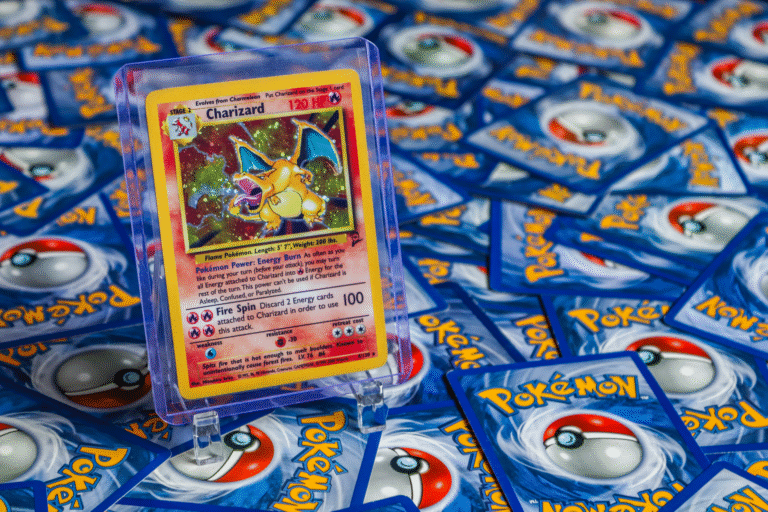
Base Set Full Heal cards have consistently outpaced the price trajectories listed in major collector guides since 2018, primarily because the vintage Pokemon card market experienced a dramatic revival that traditional price guides couldn’t track in real time. When the Pokemon Trading Card Game surged back into mainstream consciousness around 2018—driven by nostalgia, social media hype, and the 2019 release of Detective Pikachu—demand for original Base Set cards exploded across grading services, online marketplaces, and collector networks. A Near Mint Base Set Full Heal that a 2018 price guide might have valued at $15-25 began routinely selling for $40-80 by 2020-2021, with even higher prices in top grades, simply because the collector base had expanded and the cards were now being pursued by both longtime hobbyists and new entrants looking to build complete sets.
The gap between guide prices and actual market value persisted because traditional price guides—whether print editions or static online databases—update on monthly or quarterly cycles, while the real marketplace moves daily. Online sales platforms like TCGPlayer, eBay, and specialty dealer sites showed the true demand immediately, but many collectors still referenced older guides or relied on outdated benchmarks. Full Heal, being a common card from Base Set, benefits from lower barriers to entry than rare holos, making it accessible to volume buyers who collectively drive prices upward without always making headlines compared to PSA 10 Charizards.
Table of Contents
- Why Did Base Set Card Prices Accelerate After 2018?
- The Condition Scarcity Problem That Guides Consistently Underestimated
- The Grading and Authentication Explosion’s Effect on Full Heal Pricing
- How Full Heal Outperformed Other Base Set Commons and Uncommons
- Why Printed and Online Price Guides Struggle to Track Real Market Velocity
- Platform Fragmentation and Price Variance Across Marketplaces
- The Sustainability Question and Future Price Expectations for Vintage Base Set Commons
- Conclusion
Why Did Base Set Card Prices Accelerate After 2018?
The 2018-2019 period marked a turning point for Pokemon card collecting because several factors converged: millennials with disposable income rediscovered the hobby, streaming and YouTube culture made card collecting entertaining and visible to new audiences, and The Pokemon Company strategically re-released older products, legitimizing nostalgia as a collecting driver. base Set cards, being the 1999 originals and now 19-20 years old, had the narrative weight of rarity and history. Unlike reprints that came later, original Base Set cards could only depreciate in condition or stay flat—they couldn’t be newly printed, which made collecting them feel urgent to newcomers and reassuring to longtime holders.
Full Heal specifically benefited because while it lacks the chase-card status of holos, it’s still required for set completers. A collector building a complete Base Set in Mint or Near Mint condition needs every card, and Full Heal is a legitimate part of that puzzle. The estimated print run of commons from Base Set was substantially lower than modern sets due to limited production in 1999, meaning even common cards carry scarcity. A 2018 price guide might have undervalued this by treating all commons as essentially worthless, while the actual market recognized that Mint copies were genuinely hard to find without spending hundreds on heavily played examples.

The Condition Scarcity Problem That Guides Consistently Underestimated
Collector guides often quote prices for “Near Mint” or “Mint” conditions without fully accounting for how rare those grades actually are in 25-year-old cards that were played with, stored poorly, or exposed to humidity and light. A Base Set Full Heal that is truly Near Mint (light wear, centering nearly perfect, no creases) is exponentially rarer than a Lightly Played or Moderately Played copy. Guides might list “Near Mint” at $20, but they rarely updated to reflect that actual Near Mint sales were happening at $50-100 because supply couldn’t meet demand at the guide price. The introduction of comprehensive grading through PSA and BGS created a transparency problem for guides: when a card could be definitively graded as PSA 8 (Near Mint-Mint) or PSA 7 (Near Mint), the market had hard data on what those cards actually sold for.
A PSA 8 Base Set Full Heal from 2020 onwards typically commanded 4-6x what an ungraded “Near Mint” copy would theoretically be worth according to mid-2010s guides. The guides had no way to track this disaggregation of the market because they didn’t have room for grade-specific pricing data in the way that modern online databases do. A significant limitation is that condition assessment is subjective without grading. A seller might claim their card is “Near Mint,” but if it has a slight gloss wear or a half-millimeter centering issue, it’s actually Excellent or Excellent-Mint. buyers learned to distrust ungraded vintage cards, which depressed the market for raw Full Heals and drove buyers toward PSA and BGS services, creating a two-tier market that guides couldn’t easily represent.
The Grading and Authentication Explosion’s Effect on Full Heal Pricing
When PSA’s turnaround times were weeks rather than months in 2018-2019, grading a common Base Set card like Full Heal was economically rational for dealers and collectors because the grading cost ($10-20) could be recovered by the price premium a slab added. A raw Near Mint Full Heal might sell for $30, but a PSA 8 copy could reliably fetch $60-80 because buyers trusted the grade and condition assessment. This created a feedback loop: more people sent cards to be graded, more graded examples entered the market, and the market’s reference points shifted from raw cards to graded ones. Guides that didn’t differentiate by grade became obsolete almost overnight. A collector checking a 2017-era price guide for a Base Set Full Heal would have no way to know whether to expect $15 (raw, Lightly Played) or $70 (PSA 8).
By 2020, virtually every price-conscious buyer checking value used graded comps on eBay or sold listings on PWCC (Professional Sports Card Exchange), where the grade is explicit. This fragmented guides into irrelevance for serious collectors, though casual buyers still sometimes consulted them out of habit. The risk here is that even graded cards have seen occasional grade inflation or service-specific concerns. A BGS 8 may be subjectively tighter than a PSA 8, and vintage BGS slabs from the 2000s have had authenticity questions that impacted their resale value. Guides, being static, cannot address these nuanced market sentiments.

How Full Heal Outperformed Other Base Set Commons and Uncommons
Base Set contains over 100 common and uncommon cards, and they haven’t all appreciated equally. Some cards—like Squirtle, Bulbasaur, or any card depicting popular Pokemon—have consistently held or grown in value because of nostalgia and iconic status. Others, like Magnemite or Poliwag, have appreciated more modestly. Full Heal sits in a middle-tier appreciation bracket: it’s not a household-name Pokemon, but it’s also not completely forgotten. Its utility as a Trainer card (a healing item) gives it thematic relevance, and it’s historically associated with Base Set completions. Comparing Full Heal to a card like Omastar from Base Set (another uncommon from the same set, circa similar print run), Full Heal has outpaced it in value growth since 2018.
Omastar, being a Stage 2 evolution card, is less frequently needed by set completers who prioritize the core 151 Pokemon, and it has less pop culture weight. A PSA 8 Base Set Omastar might be worth $20-30, while a PSA 8 Full Heal is worth $50-70. Both have appreciated from 2018 baseline prices, but Full Heal’s broader appeal to set-builders gave it stronger demand momentum. The tradeoff is that buying Full Heal purely as an investment is less glamorous than pursuing high-grade holos, even though the percentage returns might be comparable. A $50 investment in a PSA 8 Full Heal might return 50-100% over five years, while a $500 investment in a PSA 8 Base Set Pikachu might return 150-250%. Guides don’t necessarily highlight the smaller-ticket cards where steady appreciation compounds, so casual collectors miss the opportunity.
Why Printed and Online Price Guides Struggle to Track Real Market Velocity
Price guides, whether the old Beckett Graded Card Price Guide, sports/Pokemon price book editions, or websites like the price guide, operate on a lag because they aggregate data, analyze it, and publish updates on a schedule. A website might update weekly, a print guide updates monthly or quarterly. Meanwhile, eBay has hundreds of Base Set Full Heal auctions running simultaneously, with closing prices available in real time. By the time a guide publishes that Full Heal is now worth $50, the market may have already shifted to $65 because demand continues to escalate and supply remains finite. The mechanical reason for this lag is that guides typically source their data from dealer submissions, completed sales aggregation, or advisory boards, all of which compress real-time variance into a single “representative” price.
A Full Heal might sell for $45, $55, $65, and $75 in a given week across different sellers and conditions, but the guide might publish $50 as the price, which is now the lowest end of the range. Collectors see the guide price, compare it to live listings at $65+, and either wait for a deal or realize the guide is out of date. A critical warning is that this lag creates arbitrage opportunities but also traps unsuspecting sellers. Someone listing a Full Heal at “guide price” of $40 in 2020-2021 was essentially giving away value, because the actual market was $60-70. Guides are a teaching tool, not a real-time market indicator, but many casual collectors still treat them as gospel.
Platform Fragmentation and Price Variance Across Marketplaces
A Base Set Full Heal listed on TCGPlayer might be priced at $55 (reflecting seller comps on that platform), while the same card on eBay auctions for $70 (reflecting auction dynamics and lower reserve floor), and a specialty dealer might ask $80 (reflecting expertise, curation, and direct buyer relationships). These are not market failures but rather natural pricing differences across platforms with different fee structures, audiences, and transaction models. TCGPlayer is vendor-to-consumer with fixed pricing; eBay is peer auction with price discovery; specialty dealers are personal service with expert positioning.
For Full Heal specifically, the price variance across platforms has widened as the card has appreciated. In 2015, a Full Heal might have traded for $5-8 across all platforms with minimal spread because the card was essentially a throw-in. By 2022, the same card in PSA 8 might trade for $50 on TCGPlayer, $65 on an eBay auction, and $75 at a specialty dealer, representing a 50% spread across platforms. Guides can’t track this platform variance because they don’t have the granular platform-specific data feeds that would be required.
The Sustainability Question and Future Price Expectations for Vintage Base Set Commons
Looking forward, the question is whether Base Set Full Heal prices will continue their upward trajectory or plateau. The collector base has matured since the 2018-2020 boom period, and the initial wave of nostalgic buyers has largely accumulated their cards. Newer players entering the hobby tend to pursue modern products (recent set releases) rather than vintage, which means the buyer pool for Base Set commons might not expand infinitely. However, vintage Pokemon cards have demonstrated sustained value even as new players arrive, because Base Set has an unassailable narrative: it’s the original, the icon, and the foundation of the hobby.
The role of guides going forward is likely to remain marginal. Real-time data services, graded comps on eBay, and specialty auction results have already superseded traditional price guides for serious collectors. Full Heal will continue to move based on supply-demand fundamentals, market sentiment, and broader nostalgia cycles, not because a guide says it should. The card’s status as a necessary component of a complete Base Set means it will likely retain its value better than frivolous commons, even in a contraction.
Conclusion
Base Set Full Heal cards have moved faster than collector guides suggested since 2018 because the vintage Pokemon market experienced structural change—from a niche hobby to a mainstream collecting phenomenon—that real-time digital marketplaces captured immediately while traditional guides could not. The combination of increased collector demand, grading transparency, platform fragmentation, and genuine condition scarcity created a market where actual prices diverged sharply from guide prices. A collector relying solely on a 2018 price guide would have significantly underestimated the value of their Full Heals.
If you’re evaluating or pricing Base Set Full Heal cards, abandon printed guides and instead reference recent sold comps on eBay, TCGPlayer pricing across multiple sellers, and auction results on specialty sites. Check the grade of your card honestly (or submit for professional grading if it’s high-value), compare it to recent sales of the same grade, and be prepared for the possibility that the “real” market price is substantially higher than any guide you’ve consulted. The market has moved forward; the guides are a historical reference, not a current pricing tool.