
Yes, Pokemon cards lose significant value due to even minor damage. A card in Lightly Played condition—which means it has only slight edge wear and minor surface scratches—typically sells for just 85 to 90 percent of what an identical Near Mint card commands. This seemingly small difference compounds across your entire collection. A Charizard card graded PSA 9 might fetch $500, while the same card with light corner wear drops to a PSA 8 and now sells for $250 or less. The value destruction happens quietly, through everyday handling rather than dramatic accidents.
The problem is that minor damage is nearly invisible to casual collectors but perfectly visible to serious buyers. A card that looks fine in hand—with just a subtle crease along the edge or a few microscopic surface scratches—registers immediately to dealers and graders as a step down in condition. This single step down can represent hundreds of dollars in lost value for high-end cards, or the difference between a $20 card and a $12 card for more common ones. Most Pokemon collectors don’t realize that the damage destroying their cards’ value happens during storage and routine handling, not from dramatic events. Poor storage pressure, sleeve friction, and casual shuffling accumulate wear that’s almost impossible to reverse.
Table of Contents
- How Much Value Do You Actually Lose With Damaged Pokemon Cards?
- The Role of Grading Standards and Corner Wear
- Why Graded Cards Matter More at Higher Conditions
- Storage and Handling—Where Most Damage Actually Occurs
- The Hidden Cost of Centering and Surface Issues
- Real-World Example: A Charizard Case Study
- The Future of Card Preservation and Technology
- Conclusion
How Much Value Do You Actually Lose With Damaged Pokemon Cards?
The value loss follows a predictable scale based on the card’s condition grade. Lightly Played cards—the category that includes most cards with subtle damage—retain 85 to 90 percent of Near Mint pricing according to eBay and TCGplayer standards. If your Lightly Played card would normally fetch $100 in Near Mint condition, you’re looking at $85 to $90 instead. That’s a $10 to $15 loss on a single card, which compounds across a collection of hundreds or thousands of cards. Moderately Played cards experience steeper losses, retaining only 70 to 80 percent of Near Mint value. A Moderately Played card that would be worth $100 in perfect condition now sells for $70 to $80.
The difference between Lightly Played and Moderately Played isn’t always obvious to an untrained eye—it often comes down to the visibility of wear rather than the quantity of damage—yet it costs you $10 to $20 per card in value. For serious collectors rebuilding vintage sets, this distinction matters enormously. Heavily Played cards with obvious creasing or significant surface damage retain only 50 to 60 percent of Near Mint values. At this point, you’re looking at a card that’s tournament-legal but cosmetically compromised. Below that sits Poor condition, where cards retain just 25 to 35 percent of their original value. A $100 card in Poor condition might only be worth $30, representing a two-thirds loss in value.

The Role of Grading Standards and Corner Wear
Professional graders have documented exactly what triggers value loss, and the most common culprit is corner wear. Corner wear is the primary reason cards drop grades, and even slight corner wear on otherwise perfect cards can result in a grade reduction. The corners of a card take the most abuse during storage and handling because they’re the most vulnerable points. When cards are stacked, sleeved, or shuffled, the corners absorb pressure first. The grading penalty for damage is severe. Cards with substantial flaws typically receive what’s called a “qualifier”—a notation that the card has been downgraded due to damage—and these qualified cards sell for values at least two numeric grades lower than their base grade.
This means a card that would be PSA 8 if it were perfect might receive a PSA 8 with a damage qualifier, but it sells at PSA 6 prices. That’s a two-tier drop in both grade and market value. A PSA 8 Charizard and a PSA 6 Charizard can have a price difference of 300 to 500 percent. Here’s the important limitation: professional grading doesn’t automatically add value to lower-condition cards. A PSA 5 graded card—even though it’s professionally graded—may not exceed the value of the same card sold raw (ungraded). The grading premium only kicks in at PSA 8 and higher, where collector demand for certified, high-quality examples drives significant premiums. For cards below PSA 8, the cost of grading often exceeds any value gain from certification.
Why Graded Cards Matter More at Higher Conditions
The market treats graded and raw cards very differently depending on the condition level. A Near Mint raw card and a PSA 9 graded card of the same Pokemon might sell for similar prices, but once damage appears, buyers increasingly demand professional grading to verify the actual condition. This is because visual damage is subjective, but a PSA grade is objective. A seller claiming a card is Lightly Played is making an opinion; a PSA 8 grade is a fact. For example, a raw Blastoise from the Base Set in good condition might sell for $80 to $100, but a PSA 8 certified copy of the same card could command $150 to $200.
However, drop that same card to PSA 6 condition—introducing visible wear, creasing, or centering issues—and the grading premium compresses. The PSA 6 might sell for $50 to $70, compared to a raw card that might fetch $40 to $60. The gap between raw and graded narrows considerably at lower grades because the card’s condition problems are obvious to anyone looking at it. The practical implication is that damaged cards should either be graded professionally if they’re valuable enough to justify the cost, or sold raw if they’re commons or uncommons. A $200 raw card is worth grading even at lower conditions because certification might unlock another $30 to $50 in value. A $20 raw card isn’t worth the $25 to $35 grading fee.
Storage and Handling—Where Most Damage Actually Occurs
The majority of Pokemon card damage doesn’t result from accidents or dramatic mishandling. Instead, it accumulates through normal storage and casual use. Poor storage—such as loose cards stacked without protection, cards stored in tight sleeves with high humidity, or cards exposed to pressure from other items—causes the corner wear and surface wear that destroys value. A card stored loosely in a box for years will develop visible corner wear just from the weight of other cards pressing against it. The most preventable damage comes from sleeve friction and handling pressure. When cards are repeatedly inserted and removed from sleeves, the edges gradually wear. When cards are shuffled or sorted frequently, the corners take micro-damage that accumulates into visible wear.
Humidity is another silent destroyer—high humidity can cause slight warping and surface spotting that’s nearly impossible to reverse, even after the humidity is corrected. A card stored at 60 percent humidity versus 40 percent humidity can show measurable condition differences after just six months. The limitation here is that once minor damage occurs, it cannot be undone. A card with corner wear cannot be un-worn. A card with a slight crease cannot be flattened back to perfect. Even professional restoration—which is controversial in the grading world and can disqualify cards from premium grades—cannot return a card to its original condition. The only strategy that works is prevention through proper storage in stable temperature, low humidity, card sleeves, and binders or boxes that protect against pressure and handling.
The Hidden Cost of Centering and Surface Issues
Beyond corner wear, two other damage categories destroy value quietly: centering issues and surface wear. Centering refers to how the card’s printed image aligns with the card’s edges. A perfectly centered card has even white borders on all sides. A card with off-center printing—where the image is shifted toward one edge—looks sloppy and grades lower. Poor centering is technically a manufacturing defect rather than damage, but it has the same value impact as damage. A card with poor centering might drop one full grade, costing you $50 to $200 depending on the card’s base value. Surface wear—tiny scratches on the card’s glossy surface—is invisible in casual lighting but becomes obvious under proper examination. These scratches typically come from being placed face-down on rough surfaces, shuffled with other cards, or rubbed by poor-quality sleeves.
A card with light surface wear might lose 10 to 15 percent of its value; a card with heavy surface wear can lose 40 to 50 percent. The warning here is that surface wear accelerates exponentially once it begins. A card in a low-quality sleeve develops micro-scratches faster, and each scratch makes subsequent scratches more likely. The limitation of modern card storage is that even optimal conditions don’t completely halt aging. Cards stored in acid-free sleeves in climate-controlled rooms still age slowly. The card stock itself can yellow slightly over decades, and the print can fade infinitesimally. This means that cards stored in the 1990s, even with perfect handling today, may never reach the condition of newly printed modern cards because of cumulative aging. Vintage cards that avoided damage completely during their first 25 years still might have subtle yellowing or print fading that impacts their grade relative to mint examples of the same era.
Real-World Example: A Charizard Case Study
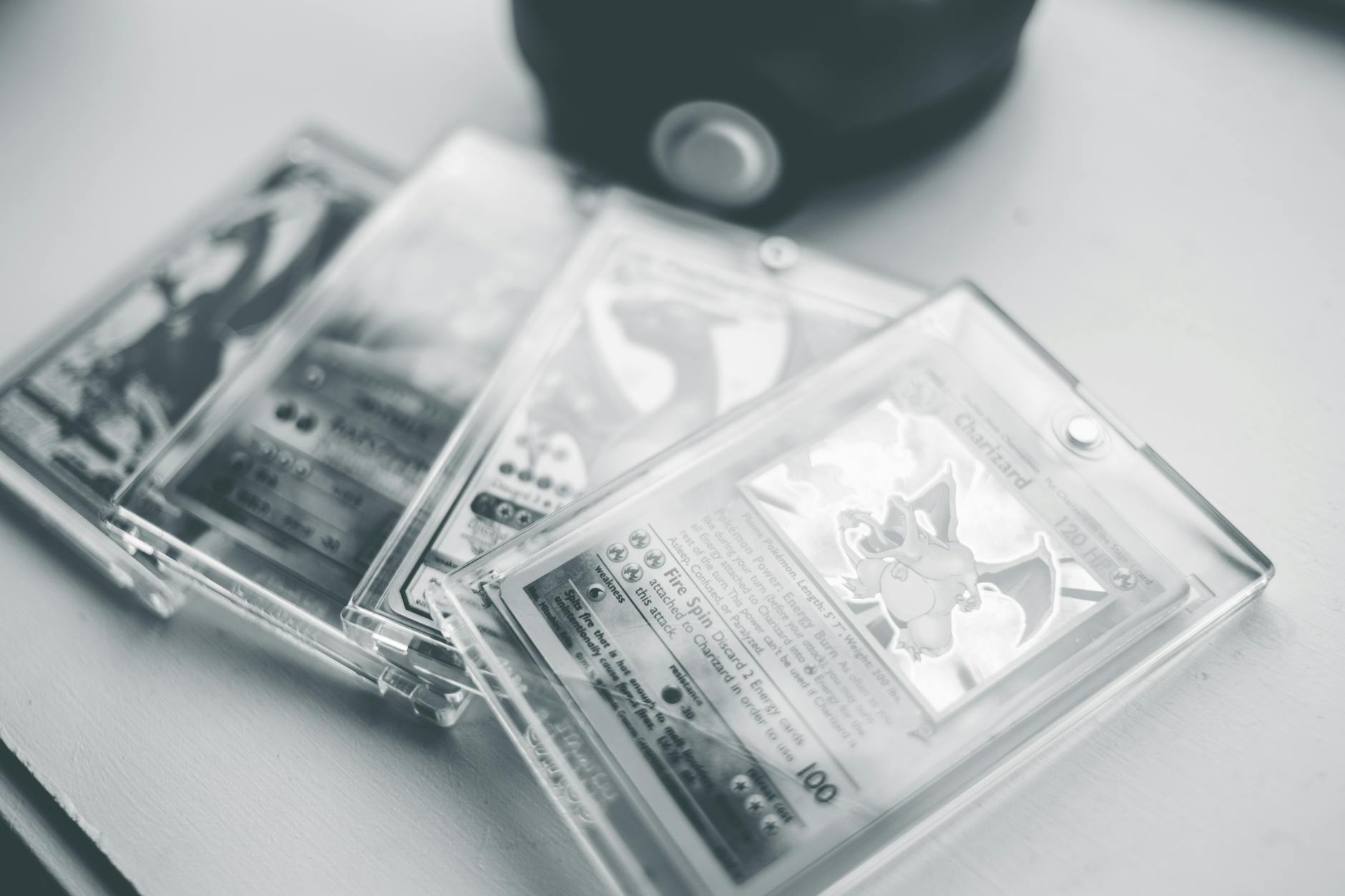
Consider a concrete example: a 1st Edition Charizard from the Base Set, one of the most valuable Pokemon cards ever printed. In Near Mint condition, a professionally graded PSA 9 example might sell for $8,000 to $10,000. The same card with light corner wear—barely noticeable without magnification—receives a PSA 8 grade and sells for $3,500 to $4,500. That’s a $4,000 to $5,500 loss from damage you might not even notice during casual inspection.
Drop the same card to PSA 7—introducing visible but not heavy wear—and the price plummets to $1,500 to $2,000. At PSA 6, you’re in the $700 to $1,000 range. The damage gradient is relentless: each grade step down costs 40 to 50 percent of the previous grade’s value. A single corner crease or cluster of surface scratches can move a card down two grades, erasing $3,000 to $4,000 in value from a single card. For lower-value cards, the percentage loss is identical—a $100 Near Mint card becomes a $40 to $50 card with similar wear patterns.
The Future of Card Preservation and Technology
The Pokemon card market increasingly recognizes that condition is tied to value, and this awareness is driving innovations in storage technology. New sleeve materials, storage boxes designed specifically for card protection, and environmental monitoring devices are becoming standard in serious collections. Some collectors now use climate-controlled storage rooms with constant humidity and temperature monitoring, similar to museums preserving artifacts. This isn’t paranoia—it’s a rational response to the massive value implications of condition.
Looking forward, as the Pokemon card market matures and early cards become older, condition will matter even more. The rarest cards in the best conditions will command exponentially higher prices while damaged versions of the same cards become less desirable. Cards that were worth $500 in Near Mint condition fifteen years ago might be worth $15,000 now—but only if they’ve maintained their condition. Damaged versions of those same cards might have appreciated from $200 to $3,000, a much slower rate of increase. The value premium for pristine condition grows over time, meaning that the damage you allow to happen today to a card worth $100 could cost you $400 or more in lost appreciation over the next decade.
Conclusion
Minor damage to Pokemon cards destroys value immediately and irreversibly. A card that looks essentially fine to the untrained eye—with light corner wear, subtle surface scratches, or slight centering issues—loses 10 to 25 percent of its market value compared to the same card in perfect condition. For high-value cards, this translates to hundreds or thousands of dollars in lost value per card. For a collection of commons and uncommons, the cumulative loss across hundreds of cards becomes substantial.
The path forward is straightforward but requires discipline: store cards in acid-free sleeves, keep them in protective binders or boxes, maintain stable temperature and humidity, and minimize handling. The damage that destroys value happens through routine handling and storage, not dramatic accidents. You can’t undo damage once it appears, so prevention is the only effective strategy. Inspect your collection now, identify cards that are at risk of further damage, and move them to protected storage before they lose more value.
You Might Also Like
- Social Media Is Driving Interest In Pokémon Cards Again
- Interest In Pokémon Cards Continues To Expand Globally
- Collectors Are Using Auctions To Find Rare Cards