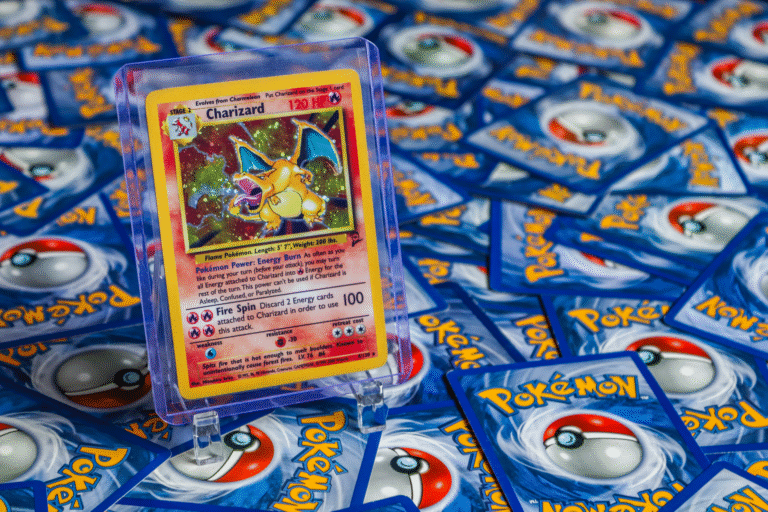
Pokémon card values rise and fall in lockstep with the franchise’s cultural relevance, and understanding this connection explains why some cards soar while others stagnate. The relationship isn’t coincidental—it’s fundamental to how card markets work. When Pokémon releases a major game, announces a new film, or reaches a cultural milestone like its 30th anniversary, collectors and speculators rush to buy, grading companies see backlogs, and card prices climb. The most dramatic recent example came in January 2026, when average Pokémon card prices jumped 46% year-over-year as the franchise celebrated three decades of existence and released strategic products timed to capture that momentum.
The numbers reflect just how tightly card values track franchise health. In the first quarter of 2026 alone, buyers spent $450 million on Pokémon cards—a staggering figure that underscores the scale of demand. Since 2004, the Card Ladder index has tracked a 6,208% growth in Pokémon card values, a trajectory that mirrors the franchise’s expansion from a regional Japanese phenomenon into a $100 billion global juggernaut spanning video games, trading cards, films, television, and merchandise. This isn’t a market driven primarily by people wanting to play the card game itself; only about 5% of buyers purchase cards to actually use them in competition. The other 95% are speculators betting that the franchise’s relevance will sustain or increase the value of their holdings.
Table of Contents
- How Does Franchise Momentum Directly Drive Card Demand?
- The Speculation Trap and Market Volatility Risk
- Grading and the Premium of Perfection
- New Game Releases as Predictable Inflection Points
- Global Distribution and the Broadening Collector Base
- The Timing Risk of Franchise Dips
- Looking Forward—Franchise Momentum as the Core Indicator
- Conclusion
How Does Franchise Momentum Directly Drive Card Demand?
Franchise momentum acts as the primary accelerant for card values. When pokémon releases a new game, players and collectors develop renewed interest in the specific Pokémon featured in that release, and the card versions of those creatures see immediate price increases. Alternate-art cards of popular Pokémon from new games typically see price jumps of $85 to $155, driven by fresh demand from players and speculators who see opportunity in nascent hype. This pattern repeated across 2025 and into 2026, with each new release generating a predictable surge in search volume, box purchases, and secondary market pricing.
The franchise’s 30th anniversary in 2026 demonstrates how milestone events translate directly into card value gains. The month-long celebration, coupled with specially designed products and strategic releases, created a surge in consumer spending that lifted the entire market. Even cards unrelated to the anniversary release saw price increases as more buyers entered the market and competing for available inventory. This phenomenon repeats with major franchise announcements—whether a new Pokémon region, a confirmed film release, or competitive esports tournament news—because each event rekindles mainstream interest.

The Speculation Trap and Market Volatility Risk
Understanding that 95% of card buyers are speculators rather than players is critical context for anyone considering purchasing cards as an investment. This creates extreme volatility and concentration risk. When the Alt-Art Umbreon V card climbed from roughly $220 in August 2025 to approximately $700 in October 2025, then surpassed $2,000 in September 2025 before dropping significantly afterward, it illustrated how quickly speculative fervor can inflate prices beyond fundamental value. Newer collectors who entered at the peak often found themselves holding cards worth a fraction of what they paid.
This boom-and-bust cycle is endemic to speculation-driven markets, and Pokémon cards are no exception. The moment franchise news cycles slow or major announcements prove disappointing, demand evaporates and speculators exit positions simultaneously. Cards that seemed expensive at $300 can drop to $75 within weeks if a franchise announcement fails to materialize or underwhelms collectors. The warning here is direct: treating Pokémon cards as a guaranteed investment vehicle is dangerous. Values depend entirely on the franchise maintaining or increasing its cultural relevance, and the entertainment industry is notoriously unpredictable.
Grading and the Premium of Perfection
Professional grading by authenticators like PSA and CGC has become inseparable from card values, especially at the high end of the market. Cards graded as a perfect 10 command significantly higher prices than near-perfect cards graded a 9, even though the visual difference is nearly imperceptible to the naked eye. This represents a psychological and practical premium: a grade-10 card is rarer, appeals to elite collectors, and carries stronger authentication that buyers will pay a premium to obtain.
For franchise-dependent cards—those that gain value specifically because a new game released or an anniversary is approaching—grading is particularly important. Speculators recognize that if they grade their cards to a 10 and the franchise remains hot, they can recover their grading costs and more. But here’s the constraint: grading companies became severely backlogged during the 2026 surge, with turnaround times extending weeks or months. By the time speculative buyers got their cards back, the initial wave of hype had often passed, leaving them holding near-perfect cards in a cooler market.

New Game Releases as Predictable Inflection Points
New Pokémon game releases function as predictable inflection points for card values, and savvy collectors time their purchases around these events. When a new game launches, the Pokémon featured in it gain popularity across the fanbase, and the corresponding trading cards—especially alternate-art or secret rare versions—see immediate demand spikes. The data is clear: cards from recently released games command higher premiums than older cards of equivalent rarity and condition.
The comparison is stark when looking at alternate-art cards across different eras. A recent alternate-art card of a popular Pokémon from this year’s game release might cost $40 to $80, while a similar alternate-art card from four years ago might be available for $10 to $20, even if the older card is technically rarer or has superior art. This price differential reflects purely the franchise relevance and recency bias of the market. For collectors trying to time purchases or trades, this suggests a strategy: older alternate-art cards from cult-favorite Pokémon might represent undervalued opportunities compared to their contemporary equivalents, though they will never capture the same speculative attention.
Global Distribution and the Broadening Collector Base
Pokémon products now ship to 76 different countries, which means the collector base driving card values is genuinely global. This geographic spread matters because franchise news that captures attention in Japan, Europe, or North America ripples across international markets simultaneously. When a new Pokémon game launches, collectors in all regions begin competing for the same limited card supplies, creating a supply-and-demand dynamic that pushes prices upward faster than it would in a single-country market. The globalization of the Pokémon card market also introduces currency fluctuations and regional price disparities that can affect values.
A card selling for $50 in the United States might trade for equivalent amounts in euros or pounds in European markets, but the baseline driver remains the same: franchise relevance. The warning here involves shipping costs and regional scarcity. Some cards are printed in higher quantities for certain regions and lower quantities for others, creating invisible price ceilings based on shipping costs. A card that costs $15 to buy and $8 to ship from Japan might reach equilibrium at $20 on the US market, even if demand would theoretically support a higher price.

The Timing Risk of Franchise Dips
Even established franchises experience periodic dips in cultural relevance, and these moments create substantial risk for card holders. When Pokémon shifts focus to less popular game mechanics, releases an unpopular character, or simply has a quiet quarter with few major announcements, the speculative base shrinks. Speculators who bought cards during a hype peak often become forced sellers during the valley, flooding the market with inventory and depressing prices.
The 2025-2026 period offers examples across multiple cards. Some alternate-art cards that climbed rapidly in September 2025 lost 60 to 70 percent of their value within six months as new releases distracted speculators and older cards became less relevant. This cyclical behavior is predictable and yet rarely priced in by buyers, who tend to extrapolate recent momentum indefinitely rather than account for regression to more modest baseline values once franchise news slows.
Looking Forward—Franchise Momentum as the Core Indicator
The relationship between Pokémon card values and franchise relevance will continue to define the market for the foreseeable future. As long as the franchise generates $100 billion in lifetime revenue and maintains cultural presence across multiple media formats, the card market will attract new entrants and speculators. The 30th-anniversary surge of 2026 demonstrated the franchise’s ability to generate demand across audiences, and upcoming game releases and films scheduled in 2026 and 2027 will likely trigger additional pricing cycles.
However, the long-term trajectory of card values depends on whether Pokémon can evolve its cultural relevance or maintain it at current levels. If the franchise stagnates, loses audience share to competitors, or produces poorly-received entries, card values will compress toward their utility value for players rather than their speculative value for investors. The franchise has survived three decades and continues to innovate, but card buyers should approach valuation through the lens of franchise health first and card characteristics second.
Conclusion
Pokémon card values are fundamentally tied to the franchise’s relevance because 95% of the market consists of speculators betting on cultural momentum rather than players seeking to use the cards. This dynamic means that major franchise announcements, new game releases, and anniversaries directly inflate card prices, while franchise quiet periods or disappointing news deflate them. The data confirms this relationship clearly: $450 million in Q1 2026 spending, 46% year-over-year price increases in January 2026, and the stark price differences between cards from recent popular games and older releases all reflect the same underlying driver—collective belief that the franchise will remain relevant and valuable.
For collectors and potential investors, understanding this mechanism offers both opportunity and warning. You can time purchases and sales around predictable franchise events and news cycles. But you should also recognize that franchise relevance is not guaranteed indefinitely, volatility can be extreme, and 95% of your market participants are speculators who will exit simultaneously if momentum shifts. The wisest approach is to view Pokémon cards as speculative assets that track franchise momentum rather than stable investments, and to diversify your holding so that you’re not dependent on a single franchise’s continued cultural dominance.