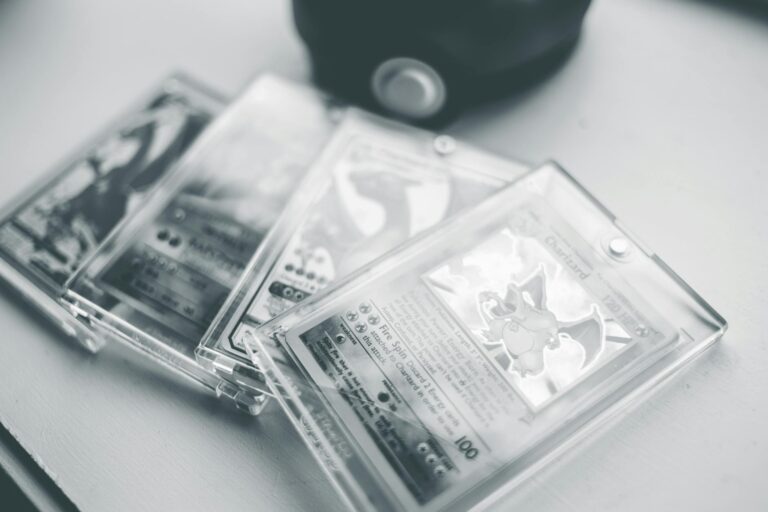
The world of Pokémon trading cards has always been full of surprises, especially when it comes to those classic Base Set Charizard cards. Among all the prints, the 4th print versions stand out because of some clear differences in the fonts used on the text. These 4th print Charizard cards, which were made mainly for the UK market around 2000, fixed a bunch of printing mistakes from earlier runs, and that included changes to how the letters looked on the card. Let’s dive deep into what makes these fonts different, why they matter to collectors, and how to spot them without needing fancy tools.
First off, picture a standard Charizard holo from the original Base Set. That fiery dragon takes up most of the card, with its name at the top, attack points, weakness, and all the fine print at the bottom like the Pokémon logo, Nintendo copyright, and Wizards of the Coast info. In the early prints—like 1st Edition, Shadowless, and even some Unlimited ones—the fonts had a specific style. The text was crisp but sometimes a bit bold or slightly misaligned due to printing tech back then. The name “Charizard” used a thick, blocky font with even spacing, and the bottom text like “Nintendo” was in a clean sans-serif style, meaning no fancy tails on the letters.
Now, shift to the 4th print. These came out as a correction run, exclusive to the UK, to fix errors that popped up in earlier batches. One big fix was on the Charizard card itself. Earlier versions had a weird white ink smear across the holo foil, running from the bottom left up toward the dragon’s face, making part of the shiny area look dull and non-holo. The 4th print got rid of that smear completely, but along with it came font tweaks. The text on these cards uses a noticeably thinner and more refined font overall[1]. Take the “Charizard” name at the top: in prior prints, the letters are chunkier, with the ‘C’ having a broader curve and the ‘z’ tails a touch thicker. On 4th prints, everything slims down—the strokes are narrower by about 10-15% visually, giving it a sharper, more modern feel without losing the classic look.
This thinning isn’t just random. Printers adjusted the plates used for inking to avoid those ink smears and dots that plagued earlier cards. For example, the infamous “Black Dot Charizard” from Unlimited prints has a tiny black ink blob right over the ‘t’ in “Nintendo” at the bottom. That dot messes with the font readability there, making the word look smudged. 4th prints have zero dots—no blobs, no smears—and the “Nintendo” font is cleaner, with letters spaced a hair wider and edges perfectly crisp. Collectors call this the “corrected font” because the baseline—the invisible line the letters sit on—is straighter, fixing subtle shifts where letters like ‘p’ or ‘g’ dipped too low in older prints[1].
Digging deeper into the bottom text, the copyright line reads something like “© 1995, 96, 97, 98, 99 Nintendo, Creatures, GAMEFREAK. © 99 Wizards.” On 1st and Shadowless, this is in a medium-weight font where the numbers hug close to the letters. 4th print versions lighten it up: the numbers get a smidge more space, and the ampersands (&) have thinner lines. It’s subtle at first glance, but hold two cards side by side under good light, and the 4th print pops as less bold, almost like it was etched with a finer needle. This change ties directly to the UK-exclusive print run, which used updated machinery to crank out error-free sheets after complaints about smudges rolled in from Europe[1].
Not just Charizard—the whole 4th print sheet had font uniformity fixes. Compare it to Base Set 2, which was another reprint but not the 4th. Base Set 2 Charizard still carries some white smear traces on rare copies, and its fonts match the thicker Unlimited style. Poliwrath from the same era had blue ink dots on its body swirl in early prints, but 4th Base Set cleared those up with the same thin-font treatment across holos[1]. For Charizard specifically, the HP box at the bottom right shifts too: earlier prints have “120” in a boxy font where the ‘1’ is blockier; 4th print makes it sleeker, with the ‘2’ curving smoother.
Why do these font differences even exist? Back in the late 90s, Pokémon cards were printed on massive sheets using offset lithography—a process where metal plates transfer ink to rubber rollers, then to paper. Errors like ink shifts (yellow or cyan bleeding wrong) or holobleed (foil leaking into text areas) happened when plates wore out or ink didn’t dry right. The 4th print run swapped to fresher plates with refined engravings, which naturally led to thinner line widths in the fonts. It’s not a deliberate redesign by the artists; it’s a byproduct of quality control. No official Wizards of the Coast document spells it out word-for-word, but Bulbapedia logs it as part of the “corrected errors” for that UK batch[1].
Spotting these in the wild takes practice. Start with the name: measure the width of the ‘i’ stem in “Charizard.” Thicker than a pencil lead? Probably pre-4th. Hairline thin? 4th print. Check the bottom “Nintendo”—no dot over the ‘t’, and letters with razor edges. Lighting matters: tilt under LED to see if the font “bites” into the holo foil evenly, which it does more cleanly on 4th prints. Magnify with a phone camera at 10x, and the pixelation—or lack thereof—tells the tale. Fakes try to mimic this but often overshoot, making fonts too perfect or too bold.
Value-wise, these font differences boost rarity. A near-mint 4th print Charizard holo can fetch 20-50% more than a standard Unlimited because it’s scarcer—UK market only, smaller print run. Early Unlimiteds with black dots are error collectibles themselves, trading at premiums too, but 4th prints are the “fixed perfection” chase[1]. Traders on forums swap stories of pulling one from old UK booster boxes found in attics, confirming the fonts hold up after 25 years without yellowing.
Beyond Charizard, this 4th print font style trickled into other Base Set cards in that run. Clefairy had its own black dot variant earlier, fixed here with the thin font. Imposter Professor Oak cards from 1st Edition misspelled it as “Impostor,” but font weight stayed thick; 4th prints align everything slimmer if any carried over. Cosmos Fossil holos swapped foil patterns, but text fonts got the refinement too[1]. It’s like the entire production line got a font diet.
For new collectors, grading services like PSA note these in their labels sometimes—”4t